[ad_1]
“It’s not the dead I fear,” says Soman Kanjiramaliyil. So, whenever the 54-year-old gets called to crime spots, where his job is to retrieve the dead and the decaying, he goes through a routine meticulously practised for over three decades — after oiling himself thoroughly, he changes into a thorthu (towel) and gets to work.
It was the same routine he followed before he entered a septic tank in Thripperumthura village in Alappuzha’s Mannar on July 2. Inside, he found a locket, a hair clip and an elastic band, all items the police think belonged to a 30-year-old woman believed to have run away with a lover 15 years ago but who investigators suspect may have been murdered by her husband.

For 32 years, Soman — fondly called Soman 174 for the section of the now replaced the Code of Criminal Procedure, 1973, which dealt with inquest proceedings — has been the go-to man for the police in Kerala’s Pathanamthitta and Alappuzha to help exhume bodies for inquest. Although his main job is as a sweeper at the Thiruvalla police station, it’s him that the police trust with retrieving even the most mutilated and maggot-infested bodies from murder, suicide, and accident scenes.
Therefore, it was Soman who entered the septic tank in Mannar. It was also he who assisted the police in 2022 when two women were allegedly tortured and murdered as part of human sacrifice rituals in Pathanamthitta’s Elanthoor village.
“It’s the living I fear,” Soman tells The Indian Express about his job now. “When I go to a place to retrieve a decomposed or mutilated body, there will be plenty of onlookers but nobody ever helps. They don’t realise that they might meet the same fate.”

Police, too, find him invaluable. According to former Pathanamthitta DSP T Rajappan, Soman understands exactly what authorities want.
“Not many will come forward to touch decomposed or mutilated bodies, even if it’s of their dear ones. But Soman has no such inhibition. He gets called to such cases almost daily and ensures no evidence is lost at a crime scene.”
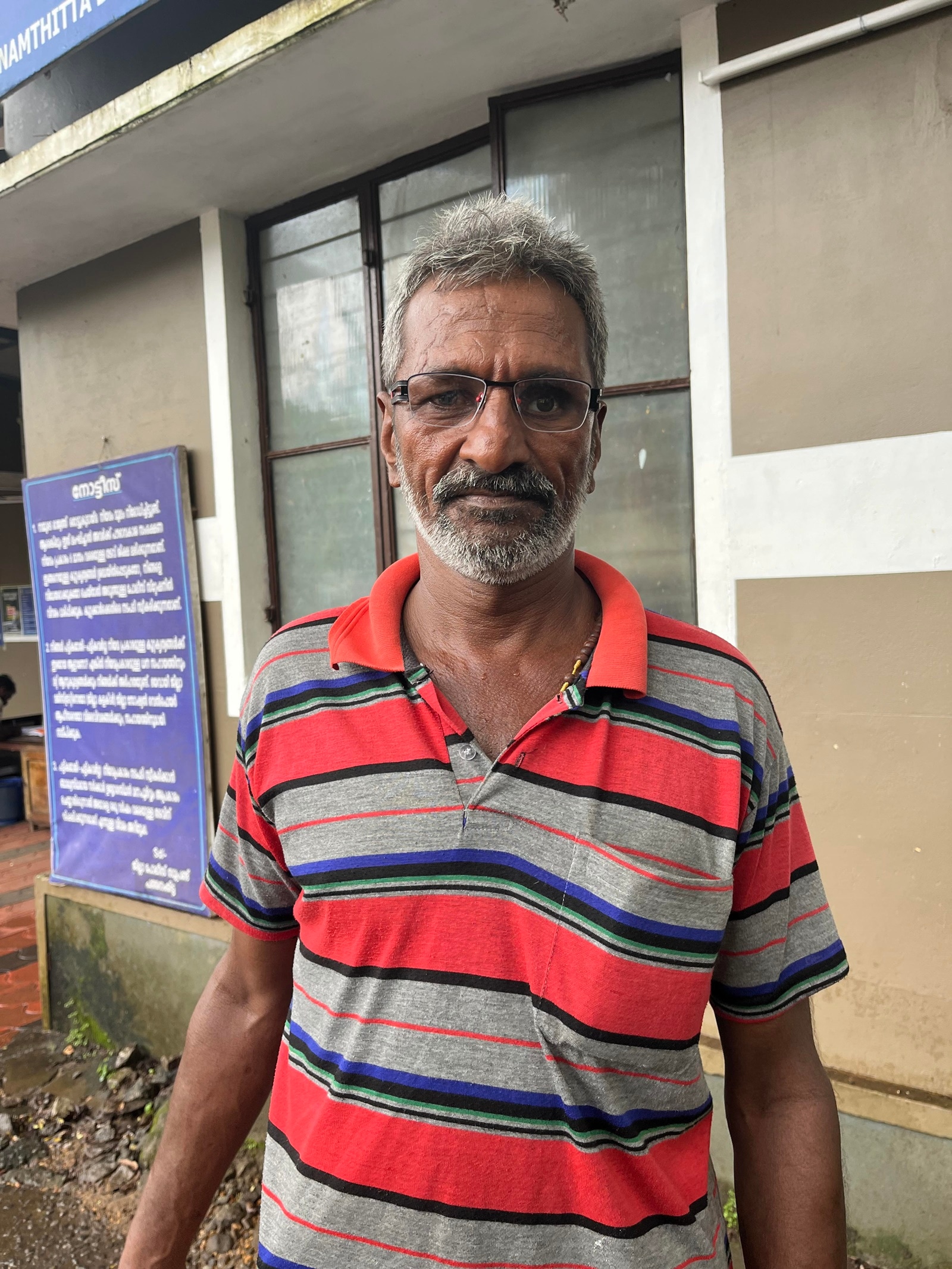 Soman Kanjiramaliyil at the Thiruvalla police station. (Express photo by Narayanan S)
Soman was in his 20s when he began retrieving bodies. That case involved a relative couple of his who were electrocuted in Othara village in the district. With no one willing to go anywhere near the charred bodies, a desperate police force sought Soman’s help.
“I took the bodies out and sent them for postmortem,” Soman says, adding that he’s recovered over 3,000 bodies since that life-altering day.
A typical workday begins at 7 am, when he reports to the police station for sweeping duties. Then he heads to a house where he’s employed as caretaker, either taking his meals at the police canteen or his own home.
On days when he has to report for police assistance, he heads there, thoroughly oiling his body to prevent anything sticking from the corpses and changing into a fresh thorthu, which he burns after the task is complete.
His phone is always on the ringer mode. He also carries around a kit with the essentials — “gloves and an extra set of clothes, because I could get a call anytime”.
“Nothing is certain in our life. It could be me tomorrow,” he says when asked why he feels a sense of responsibility towards the dead.
But there were challenges. In his early days, he would down a few drinks before work to numb himself, much to his wife Susheela’s dislike.
“But I stopped drinking on the advice of a senior woman police officer. Since then, my family has no such qualms.”
For his efforts, he gets a token sum — Rs 2,000 from police welfare fund in cases of unidentified bodies or, where the bodies are identified, whatever the relatives deem fit.
To support his family — previously also comprising his now adult children but currently only his wife — he depends on his sweeper and caretaker duties, which fetch him around Rs 15,000 a month.
It’s not about the money, he says. “I can do other things to make ends meet. Mine is a family of coconut pluckers. I’ve worked as a bus cleaner and driver, and even as a contractual employee with the electricity board in my younger days. Occasionally, I clean septic tanks.”
Misgivings about the living
Despite his stoicism today, life is hard. It was in a workplace accident while he was still with the electricity board that a wire pierced his left eye, leaving him with a prosthetic one.
And then there are those cases that shatter even the firmest restraint. Such as the time he had to fish out the body of a newborn from a river.
“When I found the tiny body, the umbilical cord was still attached. I had to wait until morning for the inquest. I carefully placed the body in a bamboo basket and secured it high on a post to protect it from scavengers and through the night, I stood guard. It was emotionally taxing.”
He also speaks about the time when he found that the road accident victim whose body he had taken for autopsy was his cousin. “I found her son there,” he says.
The Elanthoor case of alleged human sacrifice, too, shocked him. “I punched the ground with my fist first to find the correct spot where the bodies were buried, and then started digging. It’s then that I found the bodies,” he says.
He also talks about the Mannar case, when he accidentally cut his leg while entering the septic tank to look for the body. “It (my leg) was bleeding profusely. I quickly disinfected the wound and wrapped my leg in a plastic cover to continue my search.”
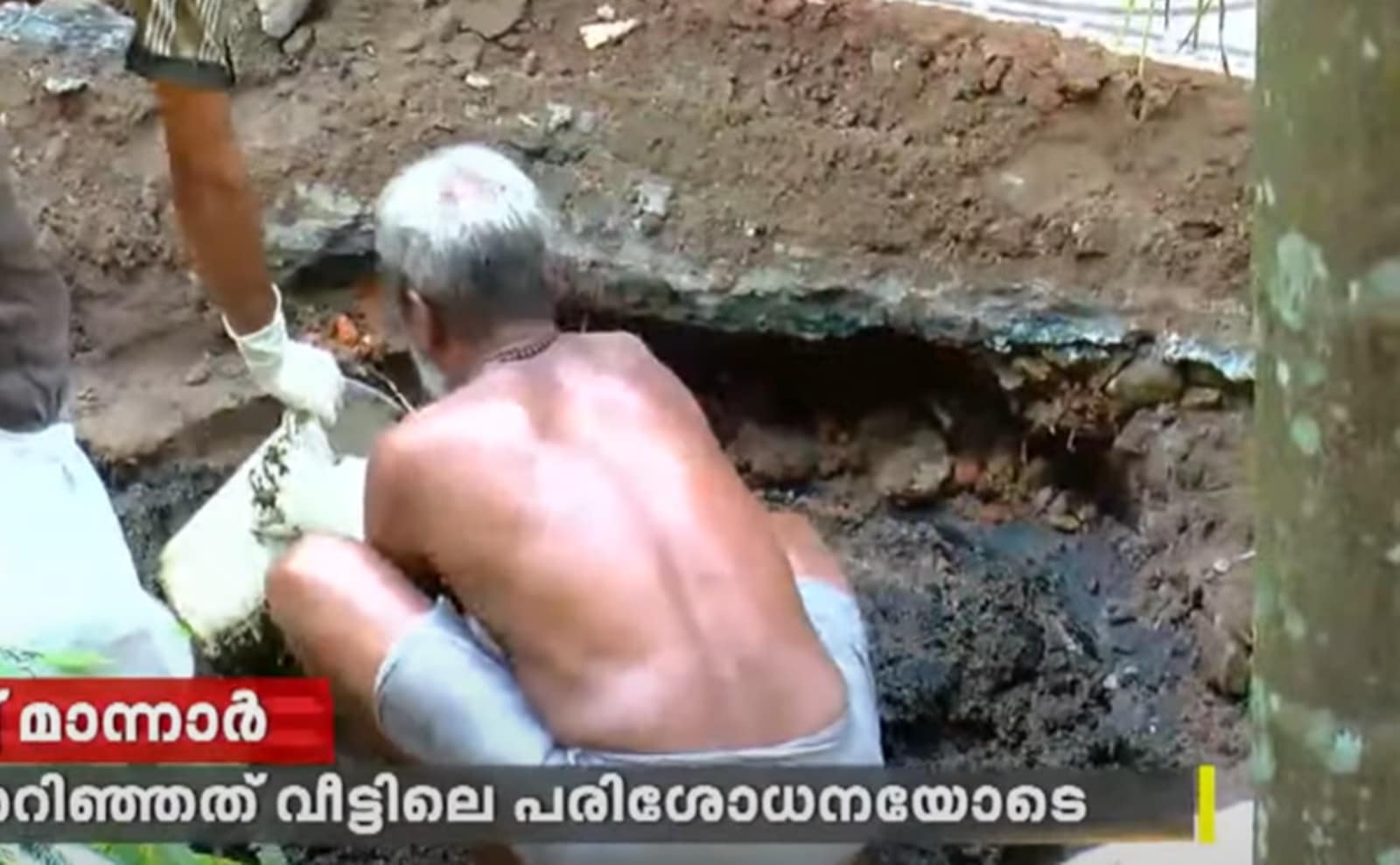 A screengrab showing Soman digging up the septic chamber in connection with the Mannar case.
On rough days, he turns to his favourite pastime — fishing. A deeply religious Christian man married to a Hindu woman, Soman also finds comfort in prayer.
“Each night, I try to watch the Japamala Prayer programme on the Catholic television channel, Shalom TV,” he says.
While the dead don’t scare him, he has deep misgivings about the living. His fear stems from being falsely accused of stealing a piece of jewellery from a corpse. It was later found in the deceased’s clothes.
He narrates another instance, when a seeming stranger near a crime scene asked for details about the case. The same man was eventually charged for the murder.
“I’ve seen the worst of human nature at accident scenes, where some people steal cash and other valuables from the dead. It’s unbelievable how low humans can stoop,” he laments.
Still, it’s the same human nature that’s helping him rebuild his house that was badly damaged in the 2018 floods. Several police officers and even some business groups have come forward with aid.
“I’m grateful to everyone who’s helping. They do so because they trust me. I’m committed to continuing my work until my last breath,” Soman says.
[ad_2]
Source link