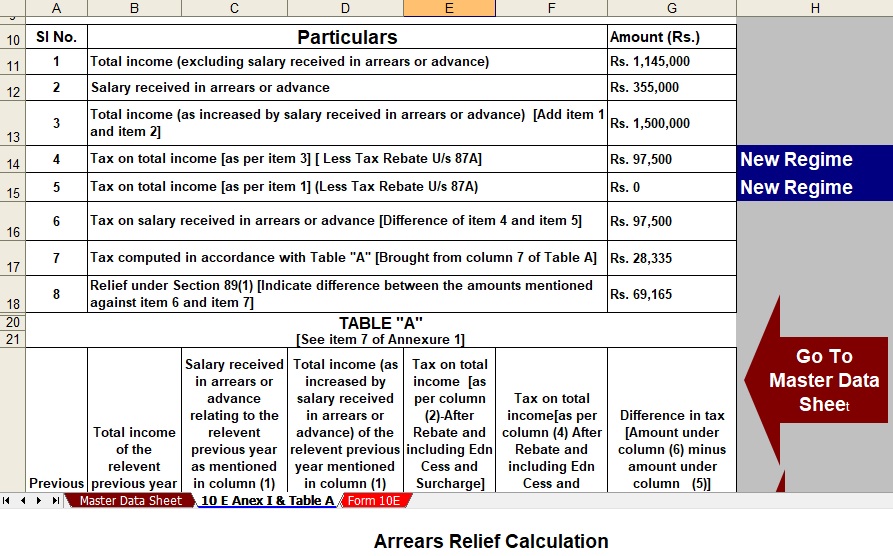

Introduction to Income Tax Arrears Relief U/s 89(1)
- You start saving tax effectively when you understand the arrears rules under Section 89(1).
- You use Form 10E to claim relief in the correct financial year.
- You reduce unnecessary tax burden when you calculate your arrears properly.
- You prevent mistakes by using an automatic income tax arrears relief calculator U/s 89(1).
- You make filing easier when you follow the step-by-step method.
- You avoid confusion by learning how arrears impact your taxable income.
- You benefit more when you compute relief before filing your ITR.
- You handle salary arrears more confidently through automation.
- You simplify calculations when you input correct figures in the calculator.
- You ensure accuracy when you use a trusted and updated tool for FY 2025-26.
- You follow tax rules better when you understand each component of arrears.
- You claim your relief correctly when you follow the Income Tax Act provisions.
- You save time when you avoid manual calculations for U/s 89(1).
- You reduce errors by relying on pre-programmed formulas.
- You increase compliance when you maintain proper documentation.
- You stay confident because the software guides you step by step.
- You minimise stress when your arrears computation becomes automatic.
- You submit Form 10E easily once your arrears relief is calculated.
- You use transitional expressions like “firstly” to move smoothly through each concept.
- You quickly recognise that relief U/s 89(1) prevents excess taxation on salary arrears.
Why Salary Arrears Occur
- You receive arrears when your employer revises your salary.
- You also receive arrears when promotions take effect late.
- You receive arrears when increments get delayed.
- You may get arrears due to revised pay commissions.
- You encounter arrears because organisations regularise old payments.
- You get arrears when court orders require retrospective pay changes.
- You see arrears added to your income even when they belong to earlier years.
- You pay more tax unintentionally when arrears push you into a higher slab.
- You mitigate excess tax using Section 89(1).
- You compare tax payable with and without arrears to compute the relief.
- You understand better how arrears distort your actual tax liability.
- You correct this distortion through the relief mechanism.
- You avoid overpayment because the law protects your income structure.
- You appreciate that Section 89(1) exists for fairness.
- You gain clarity as soon as the automatic arrears calculator computes differences.
- You proceed confidently because the calculator simplifies multi-year comparisons.
- You avoid confusion when the software separates income year-wise.
- You follow the instructions because the tool guides you through each step.
- You accept that arrears need accurate distribution across past years.
- You use the calculator to perform this distribution accurately.
Importance of Using an Automatic Arrears Relief Calculator
- You save a significant amount of time when automation performs lengthy calculations.
- You avoid mathematical errors because formulas are built in.
- You follow standardised rules consistently through the calculator.
- You ensure compliance with the latest FY 2024-25 tax slabs.
- You benefit from quick results that help you file Form 10E faster.
- You eliminate guesswork in computing past-year tax liability.
- You avoid misreporting because the calculator validates your inputs.
- You improve accuracy through automatic tax-slab application.
- You enhance reliability since the tool updates slabs automatically.
- You trust the results because they match Income Tax Department expectations.
- You increase confidence when filing your ITR.
- You move ahead quickly using the built-in features.
- You simplify the entire relief process with digital tools.
- You avoid penalties by submitting correct arrears data.
- You stay organised because the calculator structures your calculations cleanly.
- You maintain proper records since the calculator often generates printable reports.
- You complete Form 10E faster with readily available values.
- You experience smoother filing because all figures are ready.
- You free yourself from complex year-wise tax comparisons.
- You rely on the tool because it applies all tax rules automatically.
Understanding Section 89(1) in Simple Terms
- You understand Section 89(1) better when you know its purpose.
- You apply it when arrears change your tax slab unfairly.
- You calculate relief by comparing the tax payable with and without arrears.
- You see the difference clearly when using the calculator.
- You notice that the relief refunds only the excess tax burden.
- You calculate relief only for arrears of previous years.
- You learn that relief depends on old tax slabs.
- You understand that old slabs reduce excessive tax.
- You realise relief does not apply automatically; you must claim it.
- You claim relief by filing Form 10E online.
- You must complete Form 10E before filing your ITR.
- You follow rules strictly because the Income Tax Department verifies details.
- You avoid ITR processing issues by filing Form 10E on time.
- You ensure smooth processing when you submit accurate figures.
- You appreciate how simple the process becomes with automation.
- You move forward logically through each step the calculator provides.
- You complete the computation faster than manual methods.
- You stay compliant with legal procedures.
- You understand each step because the tool explains the required data.
- You appreciate Section 89(1) once you see your tax relief amount clearly.
Role of Form 10E in Claiming Relief
- You must file Form 10E to claim arrears relief successfully.
- You submit this form through the Income Tax e-filing portal.
- You provide details of the salary received in advance or arrears.
- You also specify year-wise breakups.
- You use the calculator-generated values to fill the form correctly.
- You ensure accuracy when you match figures carefully.
- You avoid discrepancies by following calculator results strictly.
- You include all affected years in the form.
- You review your details before submission.
- You verify tax amounts with and without arrears.
- You attach nothing physically because the portal stores your form digitally.
- You must complete Form 10E before submitting ITR.
- You avoid processing delays by filing on time.
- You make your filing easier when you rely on accurate digital tools.
- You maintain compliance with Income Tax rules.
- You upload your return confidently after submitting the form.
- You avoid mismatches because calculations are already precise.
- You improve filing accuracy with reliable data.
- You streamline your tax process through automation.
- You follow the sequence correctly to receive your relief.
How the Automatic Calculator Works
- You enter your salary arrears in the calculator.
- You enter the year to which the arrears belong.
- You also enter your income for those previous years.
- You input the tax paid for those years.
- You allow the calculator to apply past tax slabs automatically.
- You generate tax liability with arrears.
- You also generate tax liability without arrears.
- You compare both values instantly.
- You find the difference automatically.
- You treat the difference as relief U/s 89(1).
- You receive the final relief amount instantly.
- You use it while filing Form 10E.
- You make corrections easily if figures change.
- You depend on the calculator for accurate year-wise distribution.
- You match software results with your pay records.
- You trust the automated comparison process.
- You appreciate the clarity of the relief amount.
- You see how easily the entire process becomes manageable.
- You finalise details without stress.
- You proceed confidently to the Form 10E page.
Benefits of Using the Calculator for FY 2025-26
- You save time during tax season.
- You avoid guesswork in complex arrears calculations.
- You get correct relief because the software uses updated slabs.
- You reduce errors drastically.
- You enjoy smooth ITR filing.
- You stay compliant with tax regulations.
- You get clarity about actual tax savings.
- You benefit from modern digital tax tools.
- You proceed step by step with ease.
- You access clear instructions directly in the tool.
- You avoid confusion by following guided inputs.
- You calculate relief for multiple years quickly.
- You prevent miscalculations effectively.
- You handle complicated cases more easily.
- You enter the correct basic pay, arrears, and year details.
- You rely on the tool because it handles all arithmetic.
- You get accurate totals each time.
- You maintain consistency across records.
- You avoid manual mistakes entirely.
- You trust the calculator for reliability.
Detailed Steps for Calculating Relief
- You begin by gathering salary arrears information.
- You check your pay slips for arrear amounts.
- You identify the years to which the arrears belong.
- You note your income in those years.
- You collect tax paid during earlier years.
- You enter these details in the calculator.
- You follow the tool’s guidance carefully.
- You generate tax for the current year, including arrears.
- You generate tax for the earlier year,s excluding arrears.
- You compare the two values.
- You compute the difference automatically.
- You treat that difference as relief under Section 89(1).
- You record the final relief amount.
- You use this figure while filing Form 10E.
- You ensure consistency between your records and calculator values.
- You verify old income details again.
- You update incorrect inputs when necessary.
- You finalise the computed amount confidently.
- You complete the process without any complex calculations.
- You keep the generated report safely.
- You use it during the ITR filing stage.
- You proceed to the e-filing portal easily.
- You enter details in Form 10E precisely.
- You confirm your entries before submission.
- You avoid mismatches during processing.
- You achieve a smooth filing experience.
- You received tax relief successfully.
- You complete the entire process quickly.
- You feel satisfied with the outcome.
- You appreciate how effortlessly the automatic calculator simplifies the calculation.
Download Automatic Income Tax Arrears Relief Calculator U/s 89(1) with Form 10E from the FY 2000-01 to FY 2025-26[Update Version]